Most hosting companies ask users to choose between simplicity and control.
Basic managed hosting is easy to use, but it may limit server options and customization.
Traditional cloud hosting offers greater control, but it often requires technical knowledge and regular server management.
Cloudways tries to sit between these two choices.
The platform provides managed cloud hosting while still giving users control over server size, resources, applications, and cloud infrastructure.
It supports WordPress, Magento, Laravel, and PHP applications through its Flexible hosting service.
Cloudways also offers Autonomous hosting for WordPress websites that need automatic scaling.
This service is designed for high-traffic ecommerce stores, learning management systems, and other dynamic websites that may receive thousands of simultaneous users.
The main difference is simple.
Cloudways Flexible gives users more control over their cloud server, while Cloudways Autonomous handles scaling and infrastructure more automatically.
Its pricing is also different from many traditional hosting companies. Users can pay monthly or hourly, and the listed Flexible plans include unlimited websites and unlimited visits.
The entry-level Micro plan starts at $14 per month, while larger configurations provide more RAM, processing power, storage, and transfer bandwidth.
This Cloudways review examines its hosting options, main features, current pricing, strengths, weaknesses, and overall value for different types of websites.
What Is Cloudways?
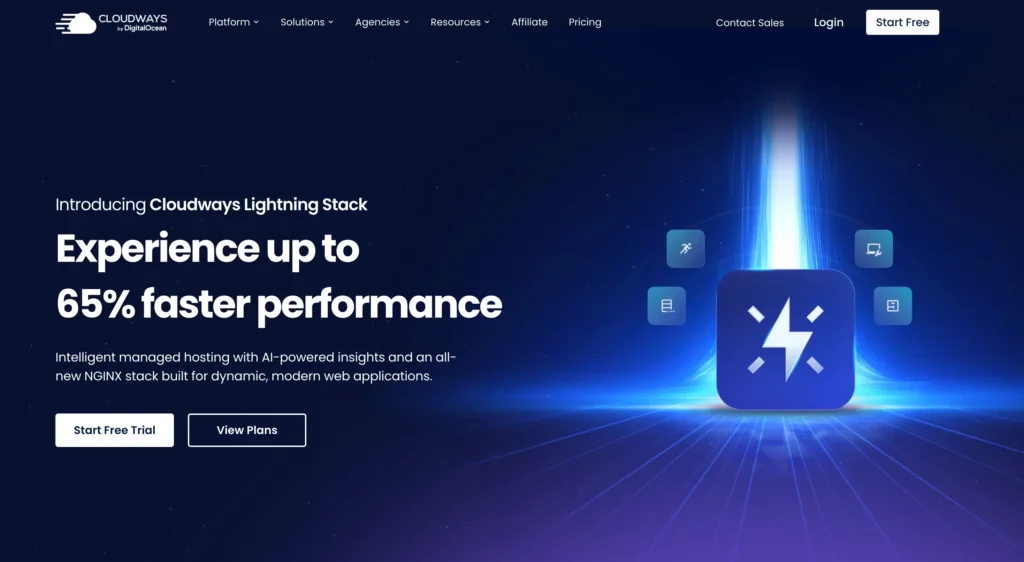
Cloudways is a managed cloud hosting platform for websites and web applications.
It allows users to launch and manage cloud servers without handling every technical server task themselves.
The platform supports:
• WordPress websites
• WooCommerce stores
• Magento stores
• Laravel applications
• PHP applications
• Blogs
• Business websites
• Ecommerce websites
• Learning platforms
• Agency projects
• Client websites
Cloudways offers two main hosting approaches.
Cloudways Flexible is designed for users who want control over their cloud provider, server resources, applications, and hosting configuration.
Cloudways Autonomous is designed for WordPress websites that need fully managed automatic scaling.
Flexible hosting can be used for several website platforms, while Autonomous hosting focuses on WordPress.
The Flexible plans listed here include hourly billing, unlimited websites, unlimited visits, NVMe storage, transfer bandwidth, AI Copilot credits, and the Cloudways Lightning Stack.
Key Features of Cloudways
Cloudways offers a different hosting experience from standard shared hosting.
Instead of placing many customers on a simple shared plan, it provides managed cloud servers with selectable resources.
1. Two Different Hosting Models
Cloudways offers Flexible and Autonomous hosting.
These services are designed for different users.
Cloudways Flexible is suitable for people who want more control over their server. Users can select a cloud provider, server type, data centre, RAM, storage, and processing resources.
Cloudways Autonomous is more hands-free.
It is designed for dynamic, high-traffic WordPress websites that need to scale automatically during traffic increases.
This gives website owners a choice between customization and automation.
Flexible hosting may suit developers, agencies, and technically confident businesses.
Autonomous hosting may suit ecommerce and learning websites that need automatic scaling without regular server adjustments.
2. Support for Several Website Platforms
Cloudways Flexible supports more than WordPress.
It can be used for:
• WordPress
• Magento
• Laravel
• PHP applications
This makes Cloudways more flexible than WordPress-only hosting providers.
A developer can manage a Laravel application, an agency can host several WordPress projects, and an ecommerce business can run a Magento store from the same general platform.
Autonomous hosting is more specialized because it is designed for WordPress.
3. Selectable Cloud Infrastructure
Cloudways Flexible allows users to choose their cloud provider.
This gives users more control over where their website is hosted and what type of infrastructure it uses.
Different cloud providers may offer different data centre locations, pricing, server resources, and performance characteristics.
This choice can be useful for businesses that need hosting close to a particular audience.
It may also help agencies select infrastructure based on a client’s location or technical needs.
4. Multiple Server Types
Cloudways allows users to select from different server categories.
These may include:
• Basic
• General Purpose
• CPU Optimized
• Standard
• Premium
The available options depend on the chosen cloud provider.
Basic servers may be enough for blogs and smaller business websites.
General Purpose servers offer a balance between memory and processing resources.
CPU Optimized servers are better suited to applications that need stronger processing power.
Premium servers may provide newer or more powerful infrastructure.
5. Monthly and Hourly Billing
Cloudways Flexible supports both monthly and hourly billing.
This is one of the platform’s most useful pricing features.
The Micro plan costs $14 per month or $0.0208 per hour.
The Small plan costs $28 per month or $0.0417 per hour.
The Medium plan costs $54 per month or $0.0804 per hour.
The Large plan costs $99 per month or $0.1473 per hour.
Hourly billing can be useful for:
• Temporary projects
• Testing environments
• Development websites
• Seasonal campaigns
• Short-term applications
• Client demonstrations
Users pay according to how long the server remains active.
This is more flexible than paying for a full year in advance.
6. Unlimited Websites
The listed Cloudways Flexible plans include unlimited websites.
This means users are not restricted to one or two websites based only on the plan name.
A single server can host multiple applications or websites, depending on the available server resources.
This can be valuable for:
• Agencies
• Freelancers
• Developers
• Website portfolio owners
• Businesses with several brands
• Affiliate marketers
However, unlimited websites does not mean unlimited server capacity.
Every site uses RAM, CPU, storage, and bandwidth.
Hosting too many demanding websites on a small server may reduce performance.
7. Unlimited Visits
The listed plans also include unlimited visits.
Cloudways does not price these plans according to a fixed monthly visitor count.
This can make costs easier to predict for websites with changing traffic.
A blog may receive a sudden increase from search engines, social media, or a popular article.
An ecommerce website may receive more visitors during a promotion.
Unlimited visits can reduce concern about traffic-based plan upgrades.
Server resources and bandwidth still matter, so very busy websites may need a larger plan.
8. NVMe Storage
All listed plans include NVMe storage.
NVMe is a faster storage technology than older traditional storage systems.
It can improve the speed at which servers read and write website files and database information.
The amount of storage increases by plan:
• Micro includes 25 GB
• Small includes 50 GB
• Medium includes 80 GB
• Large includes 160 GB
NVMe storage is useful for WordPress databases, ecommerce products, media files, applications, and cached content.
9. Transfer Bandwidth
Cloudways plans include a defined amount of transfer bandwidth.
Transfer bandwidth is the amount of data that can move between the server and website visitors.
The Micro plan includes 1 TB.
The Small plan includes 2 TB.
The Medium plan includes 4 TB.
The Large plan includes 5 TB.
These allowances are generous for many standard websites.
Bandwidth usage depends on page size, traffic, downloadable files, images, videos, and caching.
A lightweight blog will usually use less bandwidth than an image-heavy store or media website.
10. Dedicated Server Resources
Each Cloudways Flexible plan includes specific RAM and CPU resources.
The Micro plan includes 1 GB RAM and one virtual CPU.
The Small plan includes 2 GB RAM and one virtual CPU.
The Medium plan includes 4 GB RAM and two virtual CPUs.
The Large plan includes 8 GB RAM and four virtual CPUs.
More RAM helps websites handle additional processes and active users.
More CPU power helps with database queries, PHP processing, ecommerce activity, and complex applications.
Users can choose a plan based on the technical demands of their websites.
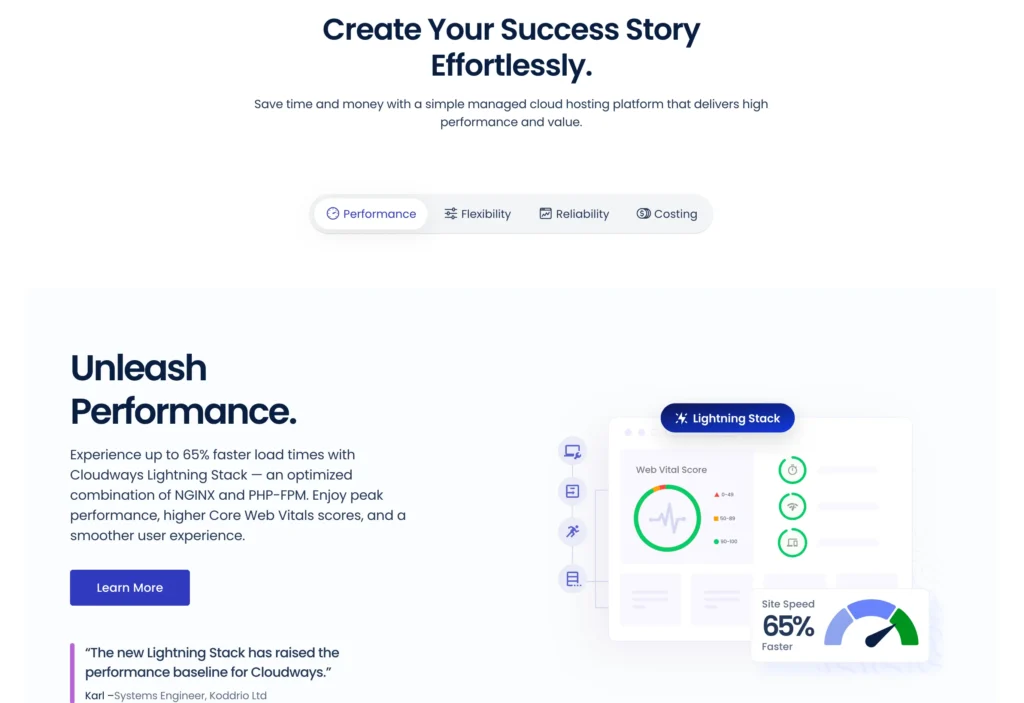
11. Lightning Stack
The listed Cloudways plans include the Lightning Stack.
This is Cloudways’ performance-focused hosting stack.
A hosting stack is the group of technologies used to process website requests, serve pages, manage databases, and deliver content.
The Lightning Stack is intended to improve page loading and application performance.
It may help WordPress, Magento, Laravel, and PHP websites handle requests more efficiently.
Actual performance will still depend on website design, plugins, code quality, images, database size, and traffic.
12. AI Copilot Credits
Every listed plan includes four free AI Copilot credits.
AI Copilot is intended to assist users with server and website management.
It may help identify issues, provide recommendations, or simplify technical tasks.
This can be useful for users who do not have advanced cloud hosting knowledge.
The included credits give customers access to a limited amount of AI assistance.
Users should review any automated recommendation before making important server changes.
13. Managed Cloud Hosting
Cloudways provides managed hosting rather than unmanaged cloud servers.
With unmanaged cloud hosting, the customer may need to configure security, server software, updates, caching, backups, and monitoring independently.
Cloudways handles or simplifies many of these tasks.
This makes cloud infrastructure more accessible to users who want performance and control without becoming full-time server administrators.
Managed hosting may save time for developers, agencies, and businesses.
14. Data Centre Selection
Cloudways allows users to view and select available data centre locations.
Choosing a location close to the main audience can reduce network delay.
For example, a website targeting visitors in Europe may benefit from a European data centre.
A business focused on Asia may prefer a data centre in that region.
The available locations depend on the selected cloud provider.
A suitable data centre can improve response time, although CDN usage and website optimization are also important.
15. Suitable for Ecommerce Websites
Cloudways can be used for WooCommerce and Magento stores.
The Large Flexible plan is specifically described as suitable for ecommerce stores and resource-intensive applications.
Ecommerce websites often need more hosting resources because they process:
• Product searches
• Customer accounts
• Shopping carts
• Checkout requests
• Payment activity
• Inventory updates
• Order information
The Medium and Large plans provide more RAM and CPU resources for these tasks.
High-traffic stores may also consider Cloudways Autonomous because it can scale automatically.
16. Automatic Scaling With Autonomous Hosting
Cloudways Autonomous is designed to scale during increases in website traffic.
Automatic scaling means the hosting environment can adjust resources when more visitors arrive.
This is particularly useful for websites with unpredictable traffic.
Examples include:
• Flash sales
• Course launches
• Product launches
• Viral articles
• Ticket releases
• Seasonal promotions
• Online events
Instead of manually upgrading the server before every campaign, the platform can handle changing demand more automatically.
17. Built for High Concurrent Traffic
Autonomous hosting is designed for websites that may receive thousands of concurrent users.
Concurrent users are visitors using the website at the same time.
This is different from total monthly traffic.
A website may receive a moderate number of monthly visitors but still experience a large spike within a few minutes.
Online stores and learning platforms often face this situation during launches, sales, or live sessions.
Autonomous hosting is intended to keep performance stable during these peaks.
18. Suitable for Learning Management Systems
Cloudways Autonomous is promoted for high-traffic learning management system websites.
LMS websites may include:
• Student accounts
• Video lessons
• Course progress
• Quizzes
• Downloads
• Membership access
• Live sessions
• Payment processing
These functions can create more server activity than a simple blog.
Automatic scaling may help when many students log in at the same time.
19. Control Over Server Size
Cloudways Flexible allows users to select the server size that matches their requirements.
A personal website can begin with the Micro plan.
A growing business can use Small.
A more demanding website can move to Medium.
An ecommerce store or resource-heavy application can use Large.
This step-by-step structure makes it easier to increase resources as the website grows.
Users do not need to move to a completely different hosting platform when they require more capacity.
20. Suitable for Developers and Agencies
Cloudways is useful for technical users who want more control than standard managed WordPress hosting provides.
Developers can host PHP and Laravel applications.
Agencies can run several client websites on one server.
Freelancers can create separate applications for different projects.
The combination of unlimited websites, selectable resources, hourly billing, and cloud provider choice makes the platform flexible.
However, users still need some understanding of server resources to choose the correct plan.
Cloudways Pricing Plans
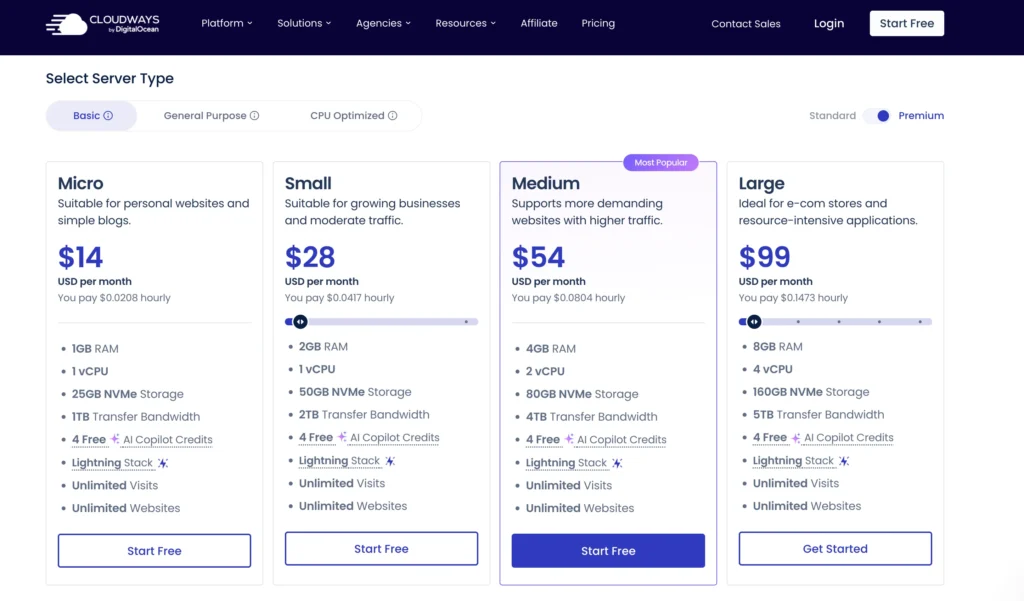
Cloudways Flexible pricing is based on the selected cloud provider, server type, and server resources.
The plans below are the listed Basic server options.
1. Cloudways Micro Plan
The Micro plan costs $14 per month.
Hourly billing costs $0.0208 per hour.
The plan includes:
• 1 GB RAM
• One virtual CPU
• 25 GB NVMe storage
• 1 TB transfer bandwidth
• Four free AI Copilot credits
• Lightning Stack
• Unlimited visits
• Unlimited websites
The Micro plan is designed for personal websites and simple blogs.
It may be suitable for:
• Small blogs
• Portfolios
• Landing pages
• Personal websites
• Low-traffic business sites
• Testing environments
The main limitation is the 1 GB RAM allowance.
Hosting several active websites on this plan may reduce performance.
2. Cloudways Small Plan
The Small plan costs $28 per month.
Hourly billing costs $0.0417 per hour.
The plan includes:
• 2 GB RAM
• One virtual CPU
• 50 GB NVMe storage
• 2 TB transfer bandwidth
• Four free AI Copilot credits
• Lightning Stack
• Unlimited visits
• Unlimited websites
The Small plan is suitable for growing businesses and websites with moderate traffic.
It provides twice the RAM and storage of the Micro plan.
This can make it a better option for:
• Small business websites
• Growing blogs
• Multiple low-traffic websites
• Small WooCommerce stores
• Client projects
3. Cloudways Medium Plan
The Medium plan costs $54 per month.
Hourly billing costs $0.0804 per hour.
The plan includes:
• 4 GB RAM
• Two virtual CPUs
• 80 GB NVMe storage
• 4 TB transfer bandwidth
• Four free AI Copilot credits
• Lightning Stack
• Unlimited visits
• Unlimited websites
The Medium plan is the most popular option in the listed pricing.
It is designed for more demanding websites with higher traffic.
The additional RAM and CPU power can help with:
• Busy WordPress websites
• Larger WooCommerce stores
• Several client websites
• Membership websites
• Laravel applications
• High-traffic blogs
4. Cloudways Large Plan
The Large plan costs $99 per month.
Hourly billing costs $0.1473 per hour.
The plan includes:
• 8 GB RAM
• Four virtual CPUs
• 160 GB NVMe storage
• 5 TB transfer bandwidth
• Four free AI Copilot credits
• Lightning Stack
• Unlimited visits
• Unlimited websites
The Large plan is intended for ecommerce stores and resource-intensive applications.
It provides the strongest resources among the listed plans.
This plan may suit:
• Large WooCommerce stores
• Magento websites
• Busy membership platforms
• High-traffic publishers
• Complex Laravel applications
• Agencies hosting many client sites
The $99 monthly price is higher, but the plan includes considerably more memory, CPU power, and storage.
Who Should Use Cloudways?
Cloudways is a suitable option for users who want cloud hosting without managing every server task independently.
It may work well for:
• WordPress website owners
• Magento store owners
• Laravel developers
• PHP application developers
• Agencies
• Freelancers
• Ecommerce businesses
• LMS websites
• Growing blogs
• High-traffic websites
• Users who prefer hourly billing
• Businesses that need automatic scaling
The Micro plan is suitable for small personal projects.
The Small plan is better for growing websites and light business use.
The Medium plan provides a stronger balance for active websites.
The Large plan is designed for ecommerce and demanding applications.
Autonomous hosting is more suitable for dynamic WordPress websites with unpredictable traffic spikes.
Is Cloudways Legit?
Yes, Cloudways is a legitimate managed cloud hosting platform.
It provides hosting for WordPress, Magento, Laravel, and PHP applications.
Its Flexible service offers selectable cloud infrastructure, monthly and hourly billing, server resource control, NVMe storage, transfer bandwidth, unlimited websites, and unlimited visits.
Its Autonomous service focuses on fully managed WordPress hosting with automatic scaling.
Cloudways is more technical than basic shared hosting, but it removes much of the difficulty of managing a cloud server independently.
Users should still understand RAM, CPU, storage, and bandwidth before selecting a plan.
Pros and Cons of Cloudways
Pros
• Two hosting models available
• Supports WordPress, Magento, Laravel, and PHP
• Monthly and hourly billing
• No long-term annual commitment required
• Unlimited websites on listed plans
• Unlimited visits on listed plans
• NVMe storage included
• Generous transfer bandwidth
• Selectable server resources
• Choice of cloud provider
• Multiple data centre locations
• Lightning Stack included
• Free AI Copilot credits
• Automatic scaling available with Autonomous
• Suitable for ecommerce and LMS websites
• Useful for agencies and developers
• Easy to increase server size as traffic grows
Cons
• More technical than standard shared hosting
• Entry plan includes only 1 GB RAM
• Email hosting may not be included as a standard feature
• Server management is simplified but not completely invisible
Final Verdict: Is Cloudways the Right Balance of Control and Convenience?
Cloudways is designed for users who want cloud hosting flexibility without the full workload of managing an unmanaged server.
That position makes it different from both cheap shared hosting and fully restricted managed hosting.
Cloudways Flexible gives users control over server size, cloud provider, data centre, applications, and billing. It supports WordPress, Magento, Laravel, and PHP, making it useful for a wider range of projects.
Cloudways Autonomous takes a different approach. It focuses on WordPress websites that need automatic scaling and hands-free infrastructure management.
The Micro plan is affordable for one small project, but its 1 GB RAM limit means it should not be overloaded with several active websites.
The Small plan provides more practical resources for growing businesses.
The Medium plan is likely to suit users who manage busier websites or several projects.
The Large plan is built for ecommerce stores and applications that need stronger processing power.
Cloudways offers clear value for developers, agencies, growing businesses, and website owners who understand the importance of RAM, CPU, bandwidth, and storage.
Users who want the simplest possible hosting dashboard with no technical decisions may prefer a more traditional managed host.
For those who want more freedom, hourly billing, unlimited websites, and the ability to scale server resources, Cloudways provides a strong middle ground between basic hosting and direct cloud server management.