DigitalOcean is not a traditional web hosting provider built mainly for beginners.
It is a cloud infrastructure platform designed for developers, startups, software companies, and technical teams that want flexible computing resources.
The company is best known for Droplets, which are cloud-based virtual machines.
It has expanded beyond standard cloud servers and now provides application hosting, managed databases, Kubernetes, storage, AI inference, GPU-powered machines, and other infrastructure tools.
Its AI products are designed for businesses that want to build chatbots, recommendation systems, AI agents, image tools, machine learning applications, and large-scale data-processing systems.
DigitalOcean’s AI inference service starts at $0.05 per million tokens for supported models. GPU Droplets start at $1.91 per GPU per hour with an eligible multi-month contractual commitment. On-demand GPU pricing starts at $0.76 per GPU per hour, depending on the selected hardware.
Additional GPU options are also available, with prices varying by configuration.
This DigitalOcean review examines its main cloud and AI features, current pricing, advantages, limitations, and the type of customer most likely to benefit from the platform.
What Is DigitalOcean?
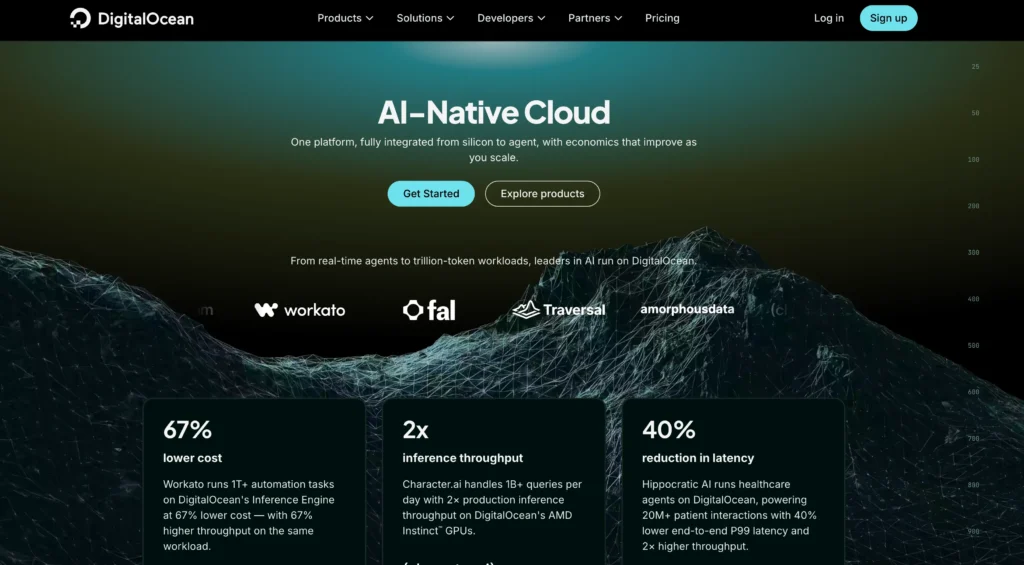
DigitalOcean is a cloud computing provider that offers virtual servers and managed infrastructure services.
Its services can be used to host:
• Business websites
• Web applications
• SaaS platforms
• APIs
• Development environments
• Databases
• Ecommerce platforms
• AI applications
• Machine learning models
• High-performance computing workloads
Instead of purchasing a fixed traditional hosting package, customers select the resources and services required for their projects.
Developers can create virtual machines known as Droplets, deploy applications through App Platform, run containers with Kubernetes, use managed databases, and add storage or load balancing.
DigitalOcean also provides AI services for businesses that want access to language models without building and maintaining their own AI infrastructure.
The platform provides considerable flexibility, but it generally requires more technical knowledge than conventional shared hosting.
Key Features of DigitalOcean
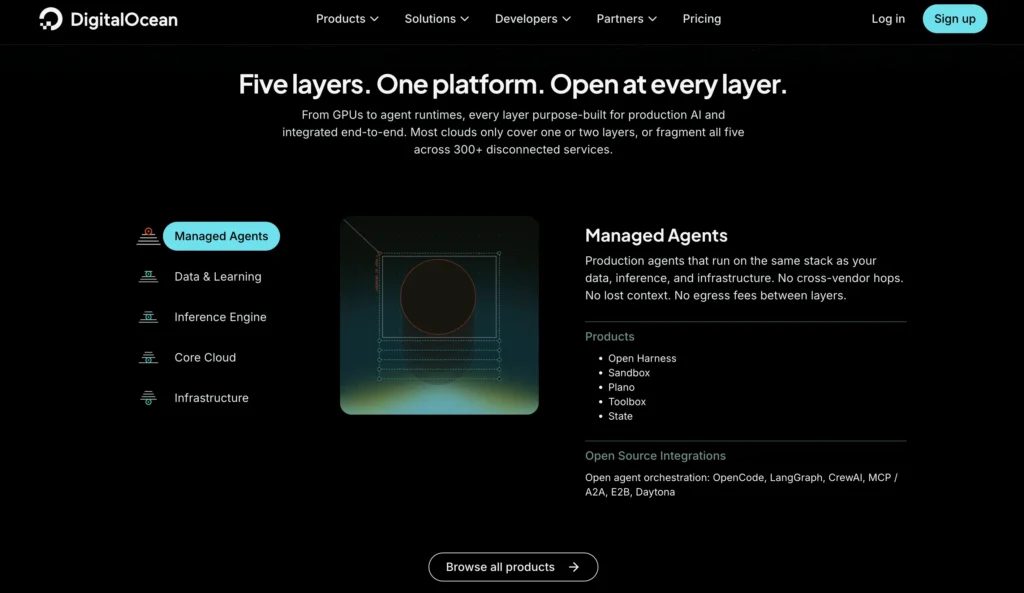
DigitalOcean combines standard cloud infrastructure with managed application, database, and artificial intelligence services.
1. DigitalOcean Droplets
Droplets are DigitalOcean’s cloud-based virtual machines.
They can be used to host websites, software, applications, APIs, development environments, and databases.
Customers can choose a Droplet according to the required:
• Processor type
• Memory
• Storage
• Operating system
• Data centre
• Workload type
Droplets provide greater control than shared hosting because users receive a defined virtual server environment.
However, customers may need to configure and maintain the server themselves unless they use a managed product or hire technical assistance.
2. AI Inference Service
DigitalOcean provides an Inference Engine for accessing and running AI models.
Inference refers to the process of sending information to a trained AI model and receiving an output.
For example, inference can be used to:
• Generate written content
• Answer customer questions
• Analyse documents
• Summarise information
• Classify data
• Generate code
• Power AI assistants
• Process images or audio
DigitalOcean allows developers to access supported models through a single API without setting up the underlying GPU infrastructure.
3. Access to Multiple AI Models
The Inference Engine provides access to models for different use cases.
Instead of being limited to one model provider, developers can compare available models according to cost, speed, context size, and capability.
This can be useful because the most expensive model is not always necessary.
A simple classification or summarisation task may work with a lower-cost model, while complex reasoning may require a more advanced option.
The ability to compare models helps businesses balance quality and operating cost.
4. Single API Deployment
DigitalOcean allows developers to access AI models through a unified API.
An API enables one software application to communicate with another service.
Developers can connect their website or application to the inference service and send prompts programmatically.
A single API can simplify development because teams do not need to build completely different infrastructure for every model.
This is useful for companies experimenting with several AI providers or changing models as their requirements develop.
5. No AI Infrastructure Management
Using managed inference removes much of the infrastructure work associated with hosting AI models.
Customers do not need to manually provision GPUs, install model-serving software, configure scaling, or maintain the underlying hardware for basic serverless inference.
This can reduce technical workload for startups and development teams.
The company can focus on building the application while DigitalOcean handles the model-serving infrastructure.
Businesses requiring complete control can instead use GPU Droplets or dedicated inference options.
6. Usage-Based Inference Pricing
DigitalOcean’s AI inference service uses token-based pricing for supported language models.
A token is a small unit of text processed by an AI model.
Customers pay according to the number of input and output tokens used.
Entry-level inference pricing starts at approximately $0.05 per million tokens, although the actual charge depends on the selected model and whether tokens are used for input, output, or caching.
This usage-based structure can be affordable for small applications because customers pay only when the service is used.
Costs can rise quickly when applications process large prompts or generate high volumes of output.
7. GPU Droplets
GPU Droplets are virtual machines equipped with graphics processing units.
GPUs are commonly used for artificial intelligence because they can process many calculations simultaneously.
DigitalOcean GPU Droplets can support:
• AI model training
• Model inference
• Deep learning
• Image generation
• Large data processing
• Complex neural networks
• High-performance computing
• Scientific workloads
They are more powerful and significantly more expensive than ordinary CPU-based Droplets.
8. AI and Machine Learning Ready Images
DigitalOcean provides AI and machine learning ready images for GPU Droplets.
A server image is a preconfigured software environment.
These images can include operating systems, GPU drivers, development tools, and common machine learning frameworks.
They help reduce the time required to prepare a new GPU server.
Developers should still understand the selected framework, storage requirements, security settings, and model configuration.
9. Single and Multi-GPU Configurations
GPU Droplets are available in different configurations, including single-GPU and multi-GPU options.
A single GPU may be enough for smaller inference workloads, experiments, or development.
Larger models and intensive training tasks may require multiple GPUs working together.
Multi-GPU servers can process larger models and datasets, but hourly costs increase substantially.
Businesses should calculate expected runtime before deploying expensive GPU resources.
10. Boot and Scratch Storage
GPU Droplets include different storage types for separate purposes.
The boot disk stores the operating system, software, and persistent configuration.
Scratch storage is intended for temporary data used during processing or model training.
Scratch disks may provide fast access but should not be treated as permanent storage.
Important model files, datasets, and outputs should be saved to persistent storage before a GPU Droplet is deleted or recreated.
11. On-Demand GPU Access
DigitalOcean offers on-demand GPU pricing starting from approximately $0.76 per GPU per hour, depending on the selected configuration.
On-demand access is useful for:
• Short experiments
• Temporary training jobs
• Testing models
• Variable workloads
• Development environments
• Occasional inference tasks
Customers can create resources when required and stop using them after the work is completed.
Careful monitoring is important because continuously running GPU servers can create high monthly bills.
12. Contract-Based GPU Pricing
Contract-based GPU Droplets start at approximately $1.91 per GPU per hour under eligible multi-month commitments.
Although a quoted contractual rate may appear higher or lower than some on-demand options, the actual comparison depends on the GPU model, server configuration, availability, and contract conditions.
Contract-based pricing is best for organisations with stable, long-term GPU requirements.
Businesses should estimate utilisation before signing a commitment because unused reserved capacity can reduce the expected savings.
13. Additional GPU Options
DigitalOcean provides additional GPU options beyond its primary GPU Droplet range.
Prices vary depending on the GPU model, processing power, memory, server resources, and commitment.
Different GPUs may be better suited to different tasks.
Some are designed for large model training, while others may be more economical for inference, visual processing, rendering, or development.
Customers should select hardware based on workload requirements rather than choosing the most powerful option automatically.
14. App Platform
App Platform is DigitalOcean’s managed application hosting service.
It enables developers to deploy applications from supported code repositories without manually configuring an entire server.
App Platform can handle parts of the deployment process, infrastructure configuration, and scaling.
It supports static sites, web services, background workers, and other application components.
Static sites can be hosted through a free tier, while paid application components start at low monthly rates.
15. Managed Databases
DigitalOcean offers managed database services.
Managed databases reduce the amount of maintenance customers must handle directly.
The platform may assist with tasks such as updates, backups, availability, and database infrastructure.
This can be useful for SaaS platforms, ecommerce stores, applications, and websites containing important customer data.
Managed services generally cost more than installing a database manually on a Droplet, but they can reduce operational risk.
16. Kubernetes Support
DigitalOcean Kubernetes helps businesses deploy and manage container-based applications.
Kubernetes is commonly used for applications divided into multiple services or containers.
DigitalOcean does not charge separately for the Kubernetes control plane under its standard pricing structure. Customers pay for the underlying compute, storage, load balancers, and other resources they use.
Kubernetes is powerful but requires technical knowledge and is unnecessary for most small websites.
17. Predictable Cloud Billing
DigitalOcean is known for presenting cloud resources with relatively clear hourly or monthly pricing.
Standard Droplets now use granular billing, which can help control the cost of short-lived workloads.
Customers can estimate expenses using the pricing calculator before creating infrastructure.
Cloud bills can still become complicated when a project uses several servers, databases, storage volumes, bandwidth, AI models, and GPU resources.
Budget alerts and regular monitoring are essential.
DigitalOcean Pricing Plans
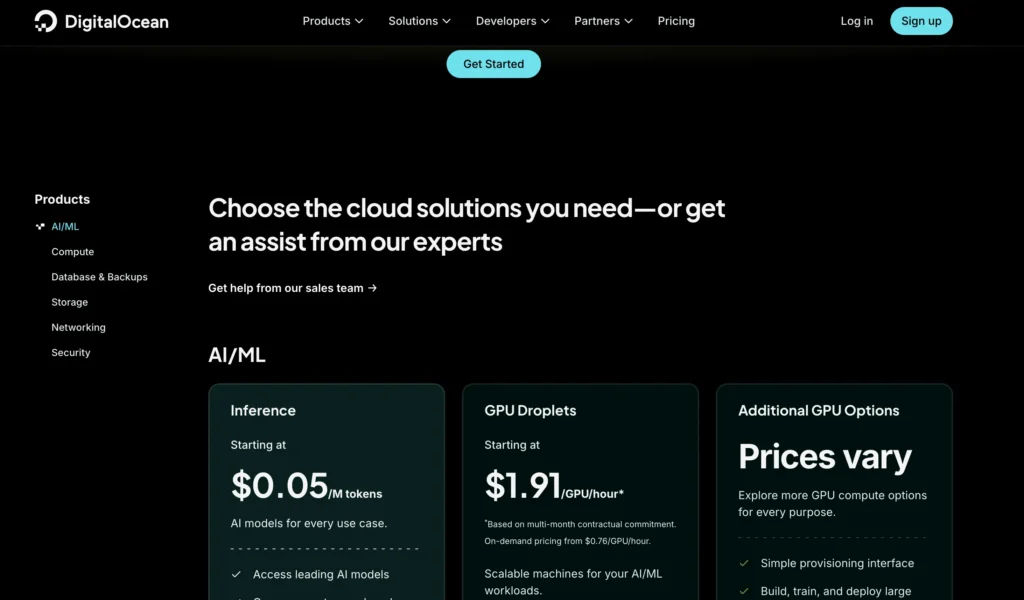
The supplied pricing focuses on DigitalOcean’s AI and GPU services.
1. DigitalOcean AI Inference
AI inference starts at $0.05 per million tokens for eligible models.
The service includes:
• Access to multiple AI models
• Comparison of price and capability
• Single API deployment
• No basic infrastructure management
• Usage-based billing
• Support for different AI use cases
This option is best for startups and developers building AI features without hosting models themselves.
Its main limitation is that pricing varies by model, and output tokens can cost more than input tokens.
2. DigitalOcean GPU Droplets
GPU Droplets start at $1.91 per GPU per hour with an eligible multi-month contractual commitment.
On-demand options start at $0.76 per GPU per hour, depending on the hardware.
GPU Droplets support:
• AI model training
• Model inference
• Neural network processing
• Large datasets
• Deep learning
• High-performance computing
This service is best for development teams that need direct access to GPU-powered virtual machines.
The main limitation is cost. Leaving a powerful GPU server active when it is not being used can become expensive.
3. DigitalOcean Additional GPU Options
Additional GPU options are available with variable pricing.
The service includes:
• Different GPU hardware choices
• Simple provisioning
• Support for building and training models
• On-demand workload scaling
• Options for different performance needs
These configurations are best for organisations with specialised requirements that are not met by the standard GPU Droplet choices.
Customers may need to contact DigitalOcean or review individual hardware pricing before deployment.
Who Should Use DigitalOcean?
DigitalOcean may be suitable for:
• Software developers
• Startups
• SaaS companies
• AI development teams
• Machine learning engineers
• Digital agencies
• DevOps professionals
• Application developers
• Data-processing teams
• Businesses needing scalable cloud servers
It is less suitable for beginners who simply want a domain, cPanel, email hosting, and a basic WordPress website.
Such users may find conventional shared hosting easier to manage.
Is DigitalOcean Legit?
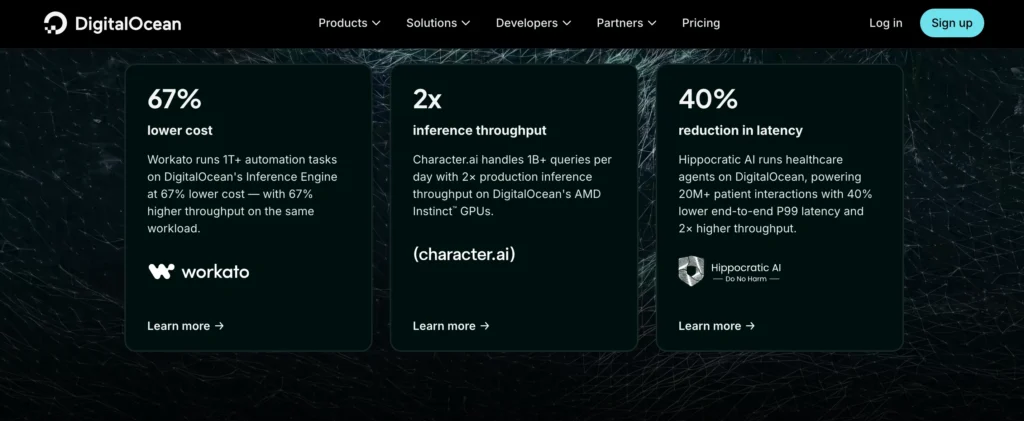
Yes, DigitalOcean is a legitimate cloud infrastructure provider offering virtual machines, application hosting, managed databases, Kubernetes, storage, AI inference, and GPU computing.
Its platform is designed mainly for technical users, developers, startups, and growing software businesses.
The larger concern is not legitimacy but complexity. Users must understand how their resources are configured, secured, monitored, and billed.
Pros and Cons of DigitalOcean
Pros
• Flexible cloud infrastructure
• AI inference from $0.05 per million tokens
• Access to multiple AI models
• Unified API for model access
• No infrastructure management for serverless inference
• Powerful GPU Droplets
• On-demand and contractual GPU options
• AI-ready server images
• Single and multi-GPU configurations
• App Platform available
• Managed databases offered
• Kubernetes support
• Clear resource-based pricing
• Suitable for developers and startups
Cons
• Not designed for traditional hosting beginners
• No standard cPanel experience by default
• Server administration may be required
• GPU workloads can become expensive
• AI output-token charges may be higher
• Pricing varies between models and hardware
• Additional services increase the total bill
• Technical security management may be necessary
• Support for application code may be limited
• Poorly configured cloud resources can create unexpected costs
Final Verdict: Is DigitalOcean a Good Cloud and AI Platform?
DigitalOcean is a strong option for developers and businesses that want more control than conventional shared hosting provides.
Its Inference Engine is useful for teams that want to add AI features without managing model infrastructure. Starting prices of $0.05 per million tokens can make basic AI experiments affordable, although actual costs depend heavily on the model and usage volume.
GPU Droplets are better for teams that need direct access to GPU hardware for model training, dedicated inference, data processing, or high-performance computing.
The ability to choose on-demand or contract-based GPU resources gives businesses flexibility, but careful cost management is required.
DigitalOcean is not the easiest choice for a beginner launching a simple blog. Traditional hosting providers usually provide a more guided experience with cPanel, bundled email, and automatic WordPress management.
For developers, SaaS companies, startups, AI teams, and technical agencies, DigitalOcean provides a broad cloud platform that can support a project from early development to larger production workloads.